The Attachment Healing Workbook
GUIDED WORKBOOK
Heal Childhood Wounds, Break Relationship Patterns & Build Secure Love
The Attachment Healing Workbook
Heal Childhood Wounds, Break Relationship Patterns & Build Secure Love
You didn't choose the way you love, but you can change it. This attachment style workbook PDF takes you through the step-by-step process of understanding where your relationship patterns began, and actually doing the work to rewire them. This workbook is for you if you've been stuck in anxious or avoidant patterns and want a structured, evidence-based path to healing.
Instant download · Digital PDF · Use on tablet or print at home
The Exhausting Relational Loop
- ×Wondering why you keep repeating the same relationship patterns
- ×Feeling like you're too much or never quite enough
- ×Getting triggered and not knowing where it's coming from
- ×Chasing love that never quite feels safe or reliable
- ×Stuck in cycles you can explain but can't seem to break
Moving Toward Secure Love
- ✓Understanding exactly where your patterns began
- ✓Recognizing your triggers before they take over
- ✓Knowing how to regulate your nervous system in real time
- ✓Communicating your needs without the fear of losing someone
- ✓Moving toward love that actually feels safe, warm, and stable
Take a Look Inside the Workbook
Get a glimpse of the actual fillable PDF layouts and exercises designed for your healing journey.
Section 1: Guided Self-Assessments
Interactive worksheets to help you map your emotional triggers, relational patterns, and nervous system activation thresholds in real-time.
Section 2: Daily Somatic & Inner Child Practice
A combination of deep cognitive reframing prompts and daily nervous system regulation check-ins to make your healing process physical, not just intellectual.
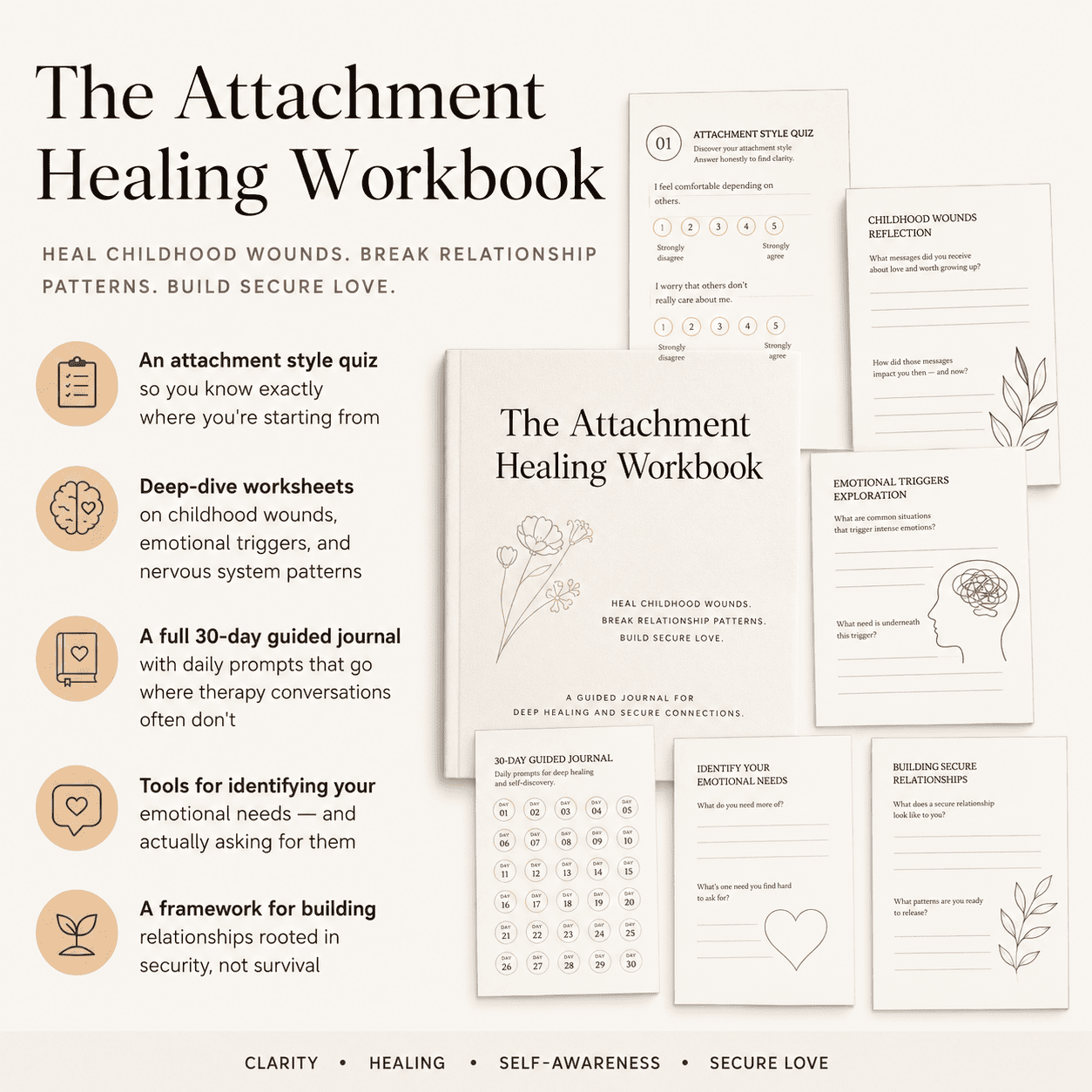
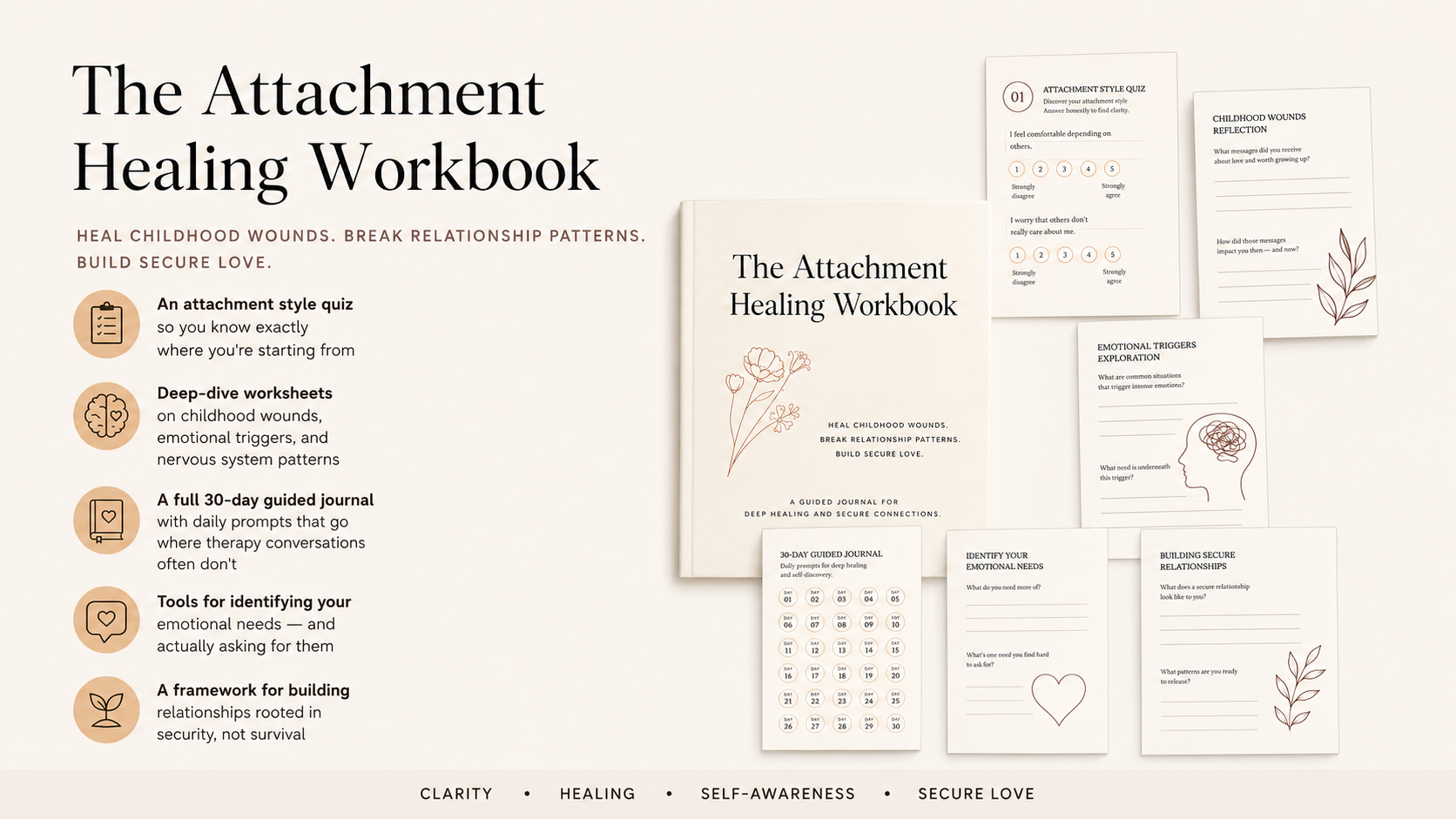
What's Inside This Attachment Healing Workbook
A comprehensive breakdown of the 5-part clinical framework and worksheets.
Discover Your Attachment Pattern
- •Chapter 1: What Is Attachment - And Why Does It Run Your Love Life?
- •Chapter 2: The Attachment Style Quiz
- •Worksheets: Relationship Triggers · Emotional Activation Scale · How I React When I Feel Unsafe
Your Childhood Wounds
- •Chapter 3: How Childhood Shapes the Way You Love
- •Chapter 4: Inner Child Work - Meeting the Part of You That Still Hurts
- •Worksheets: What I Needed But Didn't Receive · A Letter to Your Younger Self
Relationship Self-Sabotage
- •Chapter 5: The Patterns That Keep You Stuck
- •Worksheets: My Sabotage Map · The Relationship Trigger Log
Nervous System Healing
- •Chapter 6: Why Your Body Holds the Wound
- •Chapter 7: Regulation Practices That Actually Work
- •Worksheets: Body Sensation Map · Personal Calming Ritual
Becoming Securely Attached
- •Chapter 8: What Secure Love Actually Feels Like
- •Chapter 9: Building Security Within Yourself First
- •Worksheets: Boundary Scripts · Healthy Relationship Blueprint
The 30-Day Attachment Healing Journal
30 daily prompts organized into four weekly themes: Seeing Clearly → Going to the Root → Breaking the Cycle → Building the New. An actionable daily writing protocol designed to help you integrate what you learn on a somatic level.
Who This Workbook Is For
You keep repeating the same patterns
You've been in the same relationship dynamic more than once - different person, same wound. You know something is off, but the cycle keeps pulling you back. This workbook maps the exact mechanism behind that loop and shows you how to exit it.
You overthink everything in relationships
Unanswered texts send you into a spiral. Silence reads as rejection. A partner's mood shift makes your whole nervous system go on alert. You're exhausted by how much of your mental energy goes to managing relationship anxiety.
You suspect it started in childhood
You've connected enough dots to know that how you love now has something to do with how you were loved then. You're ready to actually go back to the root - not just intellectually, but with real exercises designed to shift the pattern.
Your 30-Day Attachment Healing Journal
The bonus journal section turns the workbook's insights into a daily practice. Four weeks. Four themes. Each week goes deeper than the last.
| Week | Theme | Example Prompt |
|---|---|---|
| Week 1 | Seeing Clearly | What is the relationship pattern I most want to change - and what would my life look like without it? |
| Week 2 | Going to the Root | When did you first learn that love was something you had to earn? |
| Week 3 | Breaking the Cycle | What do you chase in relationships - and what are you actually looking for underneath the chase? |
| Week 4 | Building the New | Who are you becoming through this work? Describe her. |
The journal section doesn't have prompts for the sake of prompts. Each question is designed to open something specific - and the weekly check-ins help you track what's actually shifting.
How This Workbook Heals Childhood Wounds & Relationship Patterns
Most attachment workbooks stop at awareness - they explain your style, describe your patterns, and leave you there. Understanding your attachment style is the beginning, not the destination.
This workbook goes further. Part 4 is built entirely around nervous system regulation because attachment wounds don't just live in your thoughts - they live in your body. When your heart races because a partner hasn't texted back, that's not anxiety you can think your way out of. It's a physiological response that needs a physiological answer.
The regulation practices in Chapter 7 - including the physiological sigh, somatic containment, and orienting - are research-backed tools that literally rewire the neural pathways driving your attachment responses. Used consistently, they don't just help you cope. They change the pattern at the source.
This is what earned secure attachment looks like in practice: not the absence of fear, but a nervous system that can feel the fear and come back to baseline.
To explore the neurological hook behind persistent relationship patterns, read our deep-dive analysis on why the anxious-avoidant trap feels like an addiction, or learn how to spot and navigate avoidant attachment triggers.
“You cannot think your way out of a nervous system response. You have to move through it - with your body.”- From Part 4: Nervous System Healing
Frequently Asked Questions
What is an attachment healing workbook?▼
An attachment healing workbook is a structured self-guided resource that combines psychology education, reflective exercises, and journaling prompts to help you identify your attachment style, understand how it formed in childhood, and develop the skills to move toward secure attachment in your relationships.
What are the four attachment styles?▼
The four attachment styles are: Anxious (fear of abandonment, hypervigilance in relationships), Avoidant (discomfort with closeness, emotional self-reliance), Fearful-Avoidant/Disorganized (wanting love but fearing it simultaneously), and Secure (stable foundation for trust, communication, and emotional availability). This workbook covers all four in depth.
Can I really change my attachment style?▼
Yes. Research on 'earned secure attachment' shows that adults can move toward secure attachment through consistent self-awareness work, nervous system regulation, and healthy relational experiences. This workbook is designed to guide that process step by step.
Is this workbook for anxious attachment specifically?▼
The workbook addresses all insecure attachment styles - anxious, avoidant, and fearful-avoidant (disorganized). While many readers identify most with anxious attachment patterns, the content and exercises are designed to work regardless of your specific style.
How is this different from other attachment books?▼
Most attachment books explain the concepts. This workbook makes you do the work - with a structured 5-part framework, 11 guided worksheets, nervous system regulation exercises, inner child visualization, and a 30-day healing journal. It's a process, not a reading experience.
What format is the workbook in?▼
The Attachment Healing Workbook is a downloadable PDF. You receive instant access after purchase and can use it digitally (fillable on tablet or desktop) or print it at home.
How do I access the workbook after purchase?▼
Upon successful payment, you will instantly receive an email containing a secure download link for your PDF workbook. You can download and save it to any device, import it into a tablet journaling app (like GoodNotes or Notability), or print a physical copy at home.
Do I need to be in therapy to use this workbook?▼
No - this workbook is designed for independent use. However, if you're already working with a therapist, it makes a powerful companion resource. The workbook includes a note that if any exercises feel overwhelming, pausing and seeking additional support is always okay.
Related Resources on The Psych Lens
Take the Attachment Style Quiz
Not sure which attachment style fits you? The Psych Lens Attachment Style Quiz gives you a personalized result with real insight - not just a label.
Why You Re-Read Their Last Text
Re-reading a text for a different meaning isn't overthinking — it's a documented attachment behavior. Learn the science and how to interrupt it.
Interactive CBT Thought Record
Practice pattern interruption with our guided Cognitive Behavioral Therapy tool. Refocus automatic thoughts, identify cognitive distortions, and build secure relational responses.
Content Created & Reviewed By
ThePsychLens Editorial TeamThePsychLens is a psychology and behavioral science content platform. Our editorial team consists of psychology researchers, writers, and editors dedicated to producing evidence-based self-help content grounded in peer-reviewed clinical literature. All content is reviewed for accuracy, sensitivity, and alignment with established psychological frameworks before publication. Learn about our editorial process →
Last Reviewed
June 2026
Important Clinical Disclaimer: The content and tools on ThePsychLens are provided for educational and self-help purposes only. They do not constitute professional medical, psychological, or psychiatric advice, therapy, or diagnosis, and do not create a therapeutic relationship.
If you are experiencing a mental health crisis or severe emotional distress, please contact the 988 Suicide and Crisis Lifeline (call or text 988 in the US) or text HOME to 741741 to reach the Crisis Text Line.
You've been trying to understand this long enough.
The Attachment Healing Workbook gives you the structure, the science, and the space to actually do the work.