The Green Flag Blueprint
GUIDED WORKBOOK
Become the Partner People Feel Emotionally Safe With
The Green Flag Blueprint
Become the Partner People Feel Emotionally Safe With
You already know what it looks like when a pattern takes over. Defending, going quiet, or checking your phone for the third time in ten minutes, all before you've actually decided anything. The Green Flag Blueprint is a guided workbook built around one honest question: what does a healthy relationship look like, and how do you actually become someone who has one? Across 5 parts and 20 chapters, it walks you from understanding your patterns to practicing new ones, through worksheets, scripts, and a 30-day challenge, until being safe to love stops feeling like a performance and starts feeling like who you are.
Instant download · Digital PDF · Use on tablet or print at home
The Exhausting Loop
- ×Defending, going quiet, or fixing before you've even decided to react
- ×Checking your phone again, just to see if they've replied
- ×Feeling like the same pattern follows you into every relationship
- ×Wondering if you're the reason it keeps going wrong
What Real Green Flags Look Like
- ✓Disagreement doesn't threaten the relationship anymore
- ✓Mistakes get repaired, not just apologized for and repeated
- ✓You can say "that hurt" without needing to also win the argument
- ✓You find your way back to each other after almost every rupture
Take a Look Inside
Real pages from the workbook, exactly as you'll receive them.
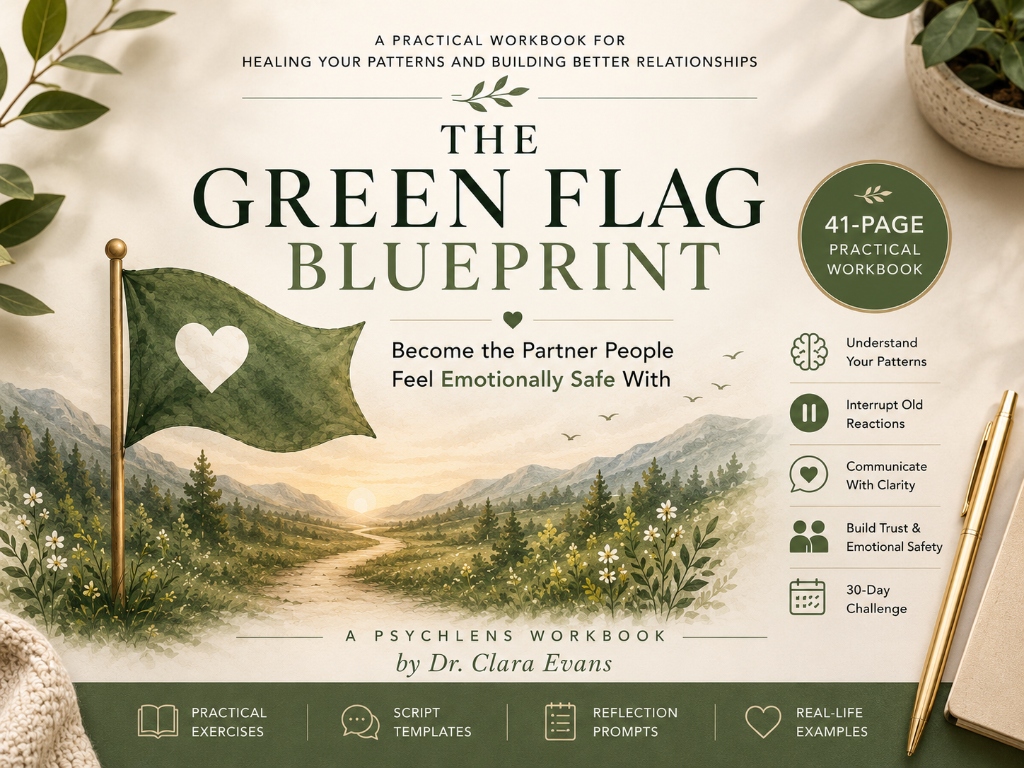
The Green Flag Blueprint - Full Workbook
Title Page
Opening + structure overview
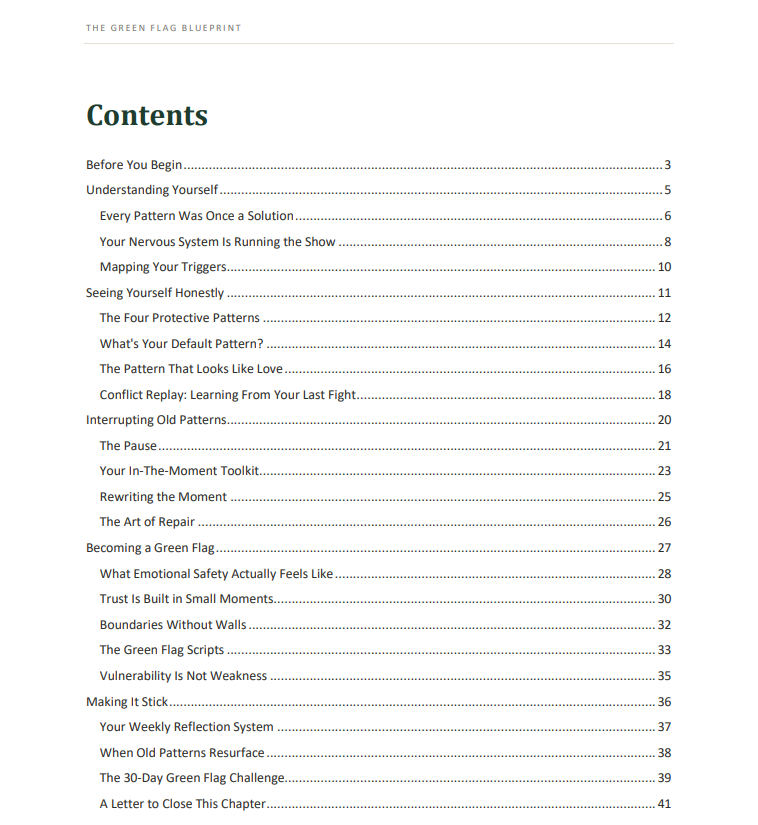
Table of Contents
All 5 parts and 20 chapters
Every part includes relationship journal prompts built to be written in, not just read. A Trigger Log, a Conflict Replay, a Weekly Reflection System. This is what a full guided system looks like.
What's Inside This Workbook
A comprehensive breakdown of the 5-part workbook and its worksheets.
Understanding Yourself
- •Chapter 1: Every Pattern Was Once a Solution
- •Chapter 2: Your Nervous System Is Running the Show
- •Chapter 3: Mapping Your Triggers
- •Worksheet: The Trigger Log
This Part traces your reactions back to where they actually started, including the idea of an attachment style, the blueprint most of us build early for closeness and conflict, so you can recognize the signs of secure attachment as you build toward them.
Seeing Yourself Honestly
- •Chapter 4: The Four Protective Patterns - Criticism, Defensiveness, Withdrawal, and Control
- •Chapter 5: What's Your Default Pattern? (self-assessment)
- •Chapter 6: The Pattern That Looks Like Love (people-pleasing)
- •Chapter 7: Conflict Replay: Learning From Your Last Fight
- •Worksheets: the Default Pattern self-assessment, Conflict Replay
No shame, no diagnosis. Just an honest look at which of the Four Protective Patterns you reach for first, and what it's actually protecting you from.
Interrupting Old Patterns
- •Chapter 8: The Pause
- •Chapter 9: Your In-The-Moment Toolkit
- •Chapter 10: Rewriting the Moment
- •Chapter 11: The Art of Repair
- •Worksheet: The Repair Script
A pattern you can see coming has far less power over you. This Part teaches the small, deliberate gap between what happens and how you respond to it, plus a full repair script for when you miss that gap anyway.
Becoming a Green Flag
- •Chapter 12: What Emotional Safety Actually Feels Like
- •Chapter 13: Trust Is Built in Small Moments
- •Chapter 14: Boundaries Without Walls
- •Chapter 15: The Green Flag Scripts
- •Chapter 16: Vulnerability Is Not Weakness
- •Worksheets: the Signs You're Building Emotional Safety checklist, the Boundary Script, The Green Flag Scripts
This is where the question "what does a healthy relationship look like?" gets a concrete answer. Chapter 12 lays out exactly what emotional safety in a relationship feels like day to day, with a relationship green flags checklist to measure where you already are.
Making It Stick
- •Chapter 17: Your Weekly Reflection System
- •Chapter 18: When Old Patterns Resurface
- •Chapter 19: The 30-Day Green Flag Challenge
- •Chapter 20: A Letter to Close This Chapter
- •Worksheets: the Weekly Reflection System, the 30-Day Green Flag Challenge
Chapter 17 gives you weekly relationship check-in questions, four prompts, five minutes, every week. Chapter 19 turns the whole workbook into a 30-day relationship challenge, structured across four themes: Awareness, Regulation, Communication, and Consistency.
The 30-Day Green Flag Challenge
28 days, structured across 4 weekly themes: Awareness, Regulation, Communication, and Consistency. Small, repeatable actions. The only kind that actually build a habit.
Who This Workbook Is For
You Keep Repeating the Same Pattern
A quiz already told you something true about your patterns. This is the next step. Not more insight, but practice.
You're Ready to Break the Cycle
Whether you're coming out of a hard relationship or just tired of watching the same thing happen again, this gives you a structured way to interrupt it before it repeats.
You Want the Words, Not Just the Insight
You already sense what you're doing. What you don't have yet is the script for what to say instead. This workbook gives you both.
Your 30-Day Green Flag Challenge
Four weeks. Four themes. Small, repeatable actions. The only kind that actually build a habit.
| Week | Theme | Example Prompt (Day 1) |
|---|---|---|
| Week 1 | Awareness | Notice one moment you reacted on autopilot. Just notice. Don't fix it yet. |
| Week 2 | Regulation | Practice the Pause once today, even in a low-stakes moment. |
| Week 3 | Communication | Use one script from Chapter 15 in a real conversation. |
| Week 4 | Consistency | Do one small thing you said you'd do, without being reminded. |
The journal section lasts through the workbook. Each week takes less than five minutes a day. Looking for instant phrasing for difficult moments? Try our free Boundary Scripts Generator.
How The Green Flag Blueprint Builds Emotional Safety
Most relationship advice skips the body. The Green Flag Blueprint doesn't. Part One explains that by the time you're aware you're upset, your nervous system has already chosen fight, flight, freeze, or fawn, long before your conscious mind gets a vote.
Part Three goes further, teaching The Pause: a small, deliberate gap between what happens and how you respond to it, along with a full in-the-moment toolkit for regulating your body while it's still convinced it's in danger.
This workbook draws on nervous-system research, attachment theory, and the concept of “bids for connection”, the small, ordinary moments that quietly build or erode trust, to give you tools that are less about insight and more about practice.
“None of these four responses are character flaws. They're your body's oldest, fastest software, running a threat scan your mind didn't authorize and can't out-argue while it's firing.”From The Green Flag Blueprint, Chapter 2
Frequently Asked Questions
What does a healthy relationship actually look like?▼
According to Part Four of the workbook, it isn't the absence of conflict. It's what happens after. In an emotionally safe relationship, disagreement doesn't threaten the bond, mistakes get repaired instead of just apologized for and repeated, and nobody has to rehearse a sentence five times before saying it out loud.
What is emotional safety in a relationship?▼
It's a set of behaviors, not a personality trait. Practiced consistently enough that the other person's body starts to believe them. Chapter 12, 'What Emotional Safety Actually Feels Like,' walks through exactly what that looks like day to day, plus a checklist to measure where you already are.
What's the difference between a red flag and a green flag?▼
A red flag is a pattern that quietly erodes trust and safety over time, even when it doesn't look dramatic from the outside. A green flag is the opposite: consistency, repair, and behavior that makes the people around you feel safer, not smaller. The Green Flag Blueprint is built entirely around the second half of that: turning your own patterns into green flags, one chapter at a time.
What are the signs of secure attachment in a relationship?▼
Chapter 1 introduces the idea of an attachment style, the blueprint most of us develop early for closeness and conflict. Signs of secure attachment tend to include comfort with both closeness and independence, direct communication under stress, and trust that a relationship can survive disagreement. Part One helps you map where your own patterns actually come from.
Is this one of the best relationship workbooks for couples?▼
It depends what you're looking for. The Green Flag Blueprint is written to one reader working on their own patterns. It uses 'you' throughout, not 'you and your partner.' If you and a partner are both doing your own inner work, you can each work through your own copy, but this isn't a shared, do-it-together couples exercise, and we'd rather tell you that upfront.
What kind of relationship journal prompts are inside?▼
Three worksheets carry most of the journaling: the Trigger Log (Chapter 3), where you track what set you off and the story you told yourself about it; Conflict Replay (Chapter 7), which breaks your last fight into five stages so you can see where it actually went wrong; and the Weekly Reflection System (Chapter 17), a four-question check-in you return to every week.
Is there a relationship green flags checklist included?▼
Yes. Chapter 12 includes a seven-item 'Signs You're Building Emotional Safety' checklist covering things like whether disagreement ends in more understanding or more distance, and whether you and your partner usually find your way back to each other after a rupture.
What are the weekly relationship check-in questions like?▼
Chapter 17's Weekly Reflection System asks four questions every week: what triggered you, how you responded, what you'd do differently next time, and one green-flag behavior you actually practiced. It's designed to take about five minutes.
Does this include a 30-day relationship challenge?▼
Yes. Chapter 19's 30-Day Green Flag Challenge, structured across four weekly themes: Awareness, Regulation, Communication, and Consistency. Each day has one small, specific action, not a big ask. The kind of habit that's actually realistic to keep.
Do I need to be in a relationship to use this workbook?▼
No. The patterns this workbook covers, how you react under stress, what you default to in conflict, show up in family relationships and friendships too, not only romantic ones. Plenty of readers use it to understand themselves before their next relationship, not just during one.
What format is the workbook in?▼
The Green Flag Blueprint is a downloadable PDF. You receive instant access after purchase and can use it digitally (fillable on tablet or desktop) or print it at home.
Related Resources on ThePsychLens
Take the Red Flag Quiz
Curious which pattern you default to first? The Red Flag Quiz shows you exactly what dynamic you bring into relationships, before you repeat it again.
Take the Am I Toxic Quiz
Not sure if it's you, them, or both? Find out which behaviors you're bringing into the dynamic, and which ones you can actually change.
The Attachment Healing Workbook
Ready to go deeper on where your patterns actually come from? This workbook starts at the root: childhood wounds, nervous system responses, and the moment love first felt conditional.
This workbook isn't a substitute for therapy and doesn't diagnose any condition. It's a practical, evidence-informed guide to one specific skill: becoming safer to love. If your patterns are tangled up with something heavier, a therapist is still the right next step. This workbook can sit alongside that work, not replace it.
Content Created & Reviewed By
ThePsychLens Editorial TeamThePsychLens is a psychology and behavioral science content platform. Our editorial team consists of psychology researchers, writers, and editors dedicated to producing evidence-based self-help content grounded in peer-reviewed clinical literature. All content is reviewed for accuracy, sensitivity, and alignment with established psychological frameworks before publication. Learn about our editorial process →
Last Reviewed
June 2026
Important Clinical Disclaimer: The content and tools on ThePsychLens are provided for educational and self-help purposes only. They do not constitute professional medical, psychological, or psychiatric advice, therapy, or diagnosis, and do not create a therapeutic relationship.
If you are experiencing a mental health crisis or severe emotional distress, please contact the 988 Suicide and Crisis Lifeline (call or text 988 in the US) or text HOME to 741741 to reach the Crisis Text Line.
You've Been Trying to Understand This Long Enough.
The Green Flag Blueprint gives you the words, the practice, and the structure to actually become the partner you're trying to be.